
 ASL
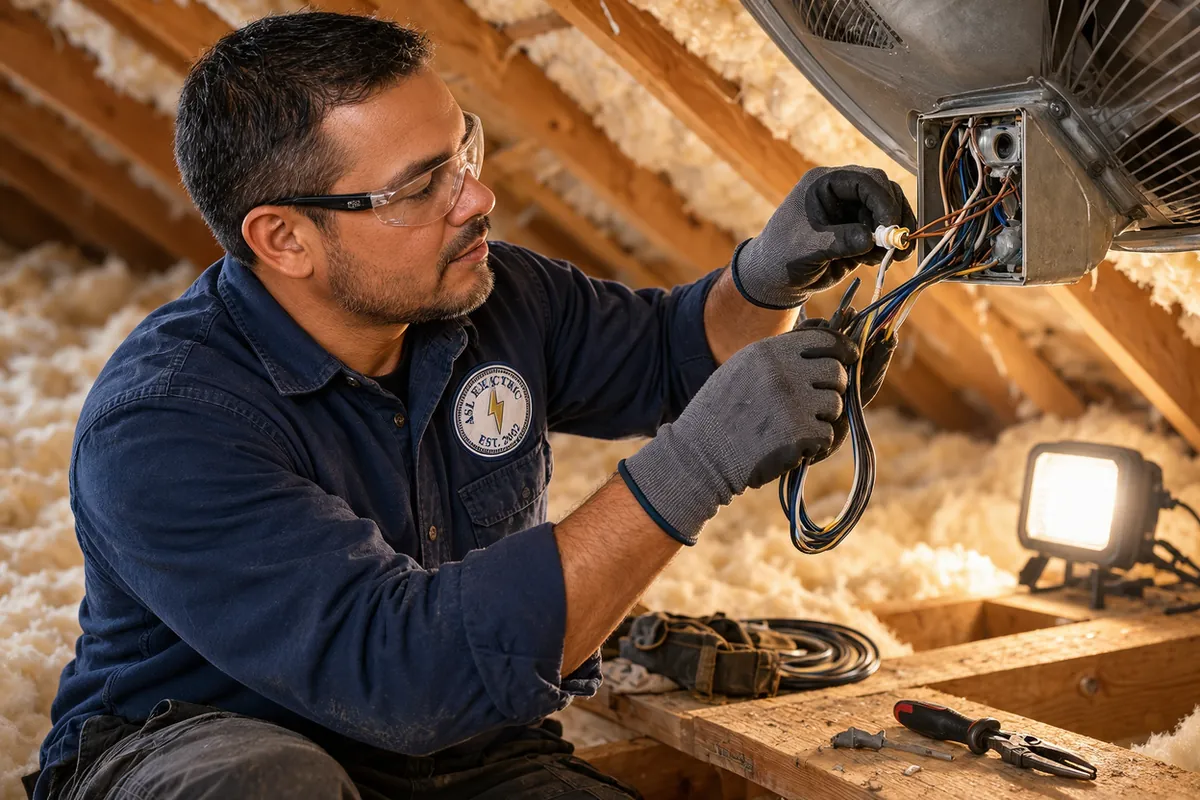
On many Orange County evenings the air outside is cooler than the air inside, and a whole-house fan can flush that heat out of the house in minutes. Attic fans keep heat from building up above your ceilings. ASL Electric installs the wiring, circuits and controls for whole-house fans and attic fans across Orange County, so they run safely, quietly and exactly when you want them.
We look at the fan you have chosen, your attic access and your panel, then run a properly sized circuit, install the switch, timer or smart control, and connect the fan. If you are replacing an older fan, we check the existing wiring and controls and bring them up to current standards.
Fan wiring we install
⚡Whole-house fan circuits
A circuit sized to the fan's requirements, run through the attic to the fan location.
⚡Attic fan wiring
Wiring and controls for gable and roof-mounted attic fans, including thermostat and humidistat controls.
⚡Timers and smart controls
Wall timers, multi-speed controls and smart controls so the fan never runs all night by accident.
⚡Replacement fans
Disconnecting old fans and wiring new ones, with the controls updated to match.
⚡Garage and workshop ventilation
Wiring for exhaust fans that keep garages and workshops cooler.
⚡Attic lighting and outlets
A light and outlet near the fan for safe maintenance access.
Signs a fan could help
Homeowners usually call us when:
- The upstairs stays hot long after sunset
- Your attic gets very hot in summer
- You want to run the AC less in shoulder seasons
- An old attic fan is noisy or stopped working
- The fan switch has no timer
- You bought a whole-house fan and need it wired
- Your fan trips a breaker
- You want smart control of ventilation
Why the wiring matters
Fans are motor loads that start and stop often and may run for hours, frequently in a hot attic. Undersized wire, loose splices or a fan sharing a crowded circuit can lead to tripping or overheated connections. A properly sized circuit, secure connections in listed boxes and good controls keep the fan reliable and safe.
How we wire a fan
Check the fan and panel
We confirm the fan's electrical requirements and that the panel has space and capacity.
Route through the attic
We run the circuit through the attic with care around insulation and framing.
Controls
We install the switch, timer, thermostat or smart control you choose.
Test and explain
We test every speed and control, and show you how to use it.
Whole-house fan or attic fan?
A whole-house fan pulls cooler outdoor air in through open windows and pushes warm indoor air up into the attic and out the vents, cooling the living space directly. An attic fan only ventilates the attic, reducing the heat that radiates down into the rooms below.
They solve different problems, and some homes use both. Your fan installer or HVAC contractor can advise on sizing and venting; we handle the electrical.
Always use a timer
Whole-house fans need open windows to work safely. A timer or smart control makes it easy to run the fan for a set period without leaving it on all night or forgetting it when windows are closed. We recommend a timer or smart control on every whole-house fan we wire.
What affects the cost of fan wiring
The main factors are the fan's electrical requirements, the distance from the panel, attic access and height, whether a new circuit is needed, the controls you choose, and whether old wiring has to be removed or corrected. We give you a free, upfront estimate.
How it works with ASL Electric
We confirm requirements, access and the circuit route.
You get a clear price for the circuit and controls.
We connect the fan and controls and show you how they work.
Whole-House & Attic Fan Wiring across Orange County
Inland Orange County cities get the most heat, and the most benefit from good ventilation. We wire whole-house and attic fans regularly in Lake Forest, Mission Viejo, Rancho Santa Margarita, Laguna Hills, Ladera Ranch and Irvine, where two-story homes hold heat upstairs. Closer to the coast, cooler evening air makes whole-house fans especially effective.
We also install bathroom exhaust fans and ceiling fans; see those pages for details.